

As a supplier of MDF Acoustic Panels, I am often asked about how these innovative products work to improve acoustics in various spaces. In this blog post, I'll delve into the science behind MDF Acoustic Panels, exploring their construction, principles of operation, and the benefits they offer.
Understanding MDF: The Foundation of Acoustic Panels
Medium - Density Fiberboard (MDF) is an engineered wood product made by breaking down hardwood or softwood residuals into wood fibers. These fibers are then combined with wax and a resin binder, and pressed under high temperature and pressure to form panels. MDF has several characteristics that make it an ideal base material for acoustic panels. It is dense, uniform in structure, and has good strength and stability.
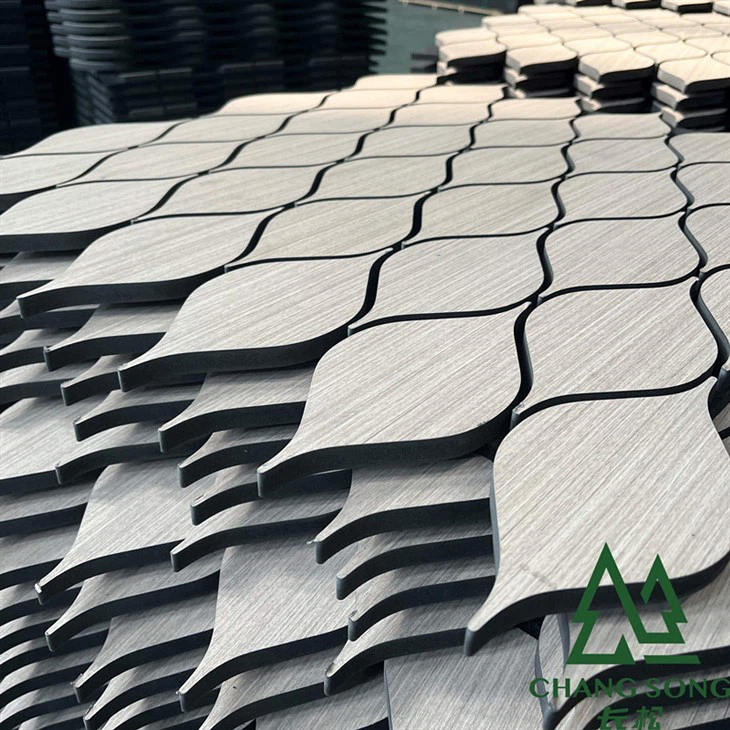

The density of MDF plays a crucial role in its acoustic performance. A higher density generally means that the material can absorb more sound energy. The uniform structure ensures that the sound waves interact with the material in a consistent manner, leading to predictable acoustic results.
How MDF Acoustic Panels Absorb Sound
Sound is a form of energy that travels in waves through a medium, such as air. When sound waves encounter an MDF Acoustic Panel, several things can happen: reflection, absorption, or transmission.
Sound Reflection
Reflection occurs when sound waves bounce off the surface of the panel. In a normal, hard - surfaced room, sound waves reflect off walls, floors, and ceilings multiple times, creating echoes and reverberation. However, MDF Acoustic Panels are designed to minimize reflection. Their surface texture and internal structure are engineered to disrupt the smooth path of sound waves, reducing the amount of sound that is simply bounced back into the room.
Sound Absorption
This is the primary function of MDF Acoustic Panels. When sound waves enter the panel, they cause the fibers within the MDF to vibrate. This vibration converts the sound energy into heat energy through a process called friction. The porous nature of the MDF allows the sound waves to penetrate deeper into the panel, increasing the amount of energy that can be absorbed.
The absorption coefficient is a measure of how well a material can absorb sound. It ranges from 0 (no absorption) to 1 (complete absorption). High - quality MDF Acoustic Panels can have absorption coefficients of 0.8 or higher in certain frequency ranges, meaning they can absorb 80% or more of the incident sound energy.
Sound Transmission
Sound transmission refers to the passage of sound through the panel and into an adjacent space. MDF Acoustic Panels also help to reduce sound transmission. The density and mass of the MDF act as a barrier to sound waves, preventing them from easily passing through to the other side. By reducing both reflection and transmission, MDF Acoustic Panels can significantly improve the acoustic quality of a room.
Construction Features that Enhance Acoustic Performance
MDF Acoustic Panels are not just simple pieces of MDF. They are often designed with specific construction features to optimize their acoustic performance.
Perforation
Many MDF Acoustic Panels are perforated. These small holes on the surface of the panel allow sound waves to enter the panel more easily. Once inside, the sound waves can interact with the internal structure of the MDF and be absorbed. The size, spacing, and pattern of the perforations can be carefully engineered to target specific frequency ranges. For example, larger perforations may be more effective at absorbing low - frequency sounds, while smaller perforations can handle high - frequency sounds.
Backing Materials
Some MDF Acoustic Panels are backed with materials such as fiberglass or rock wool. These backing materials further enhance the absorption of sound. They provide additional mass and porosity, allowing the panel to capture and dissipate more sound energy. The backing material also helps to reduce the transmission of sound through the panel, making it more effective in soundproofing applications.
Edge Sealing
Proper edge sealing is important for MDF Acoustic Panels. It prevents sound from leaking around the edges of the panel, ensuring that the sound waves are directed into the panel for absorption. Edge sealing also helps to protect the panel from moisture and damage, extending its lifespan.
Applications of MDF Acoustic Panels
MDF Acoustic Panels have a wide range of applications in different settings.
Commercial Spaces
In offices, MDF Acoustic Panels can reduce noise distractions, improve speech intelligibility, and create a more comfortable working environment. They can be installed on walls or ceilings to control reverberation and background noise. In restaurants and cafes, these panels can enhance the dining experience by reducing noise levels and creating a more intimate atmosphere.
Educational Institutions
Classrooms and lecture halls benefit greatly from MDF Acoustic Panels. They help to improve the clarity of teachers' voices, making it easier for students to understand the lessons. By reducing background noise and reverberation, these panels can also enhance concentration and learning outcomes.
Entertainment Venues
Theaters, concert halls, and recording studios require precise acoustic control. MDF Acoustic Panels can be customized to meet the specific acoustic needs of these venues. They can be used to shape the sound, reduce echoes, and ensure that the audience hears the performance as intended.
Benefits of Choosing MDF Acoustic Panels
Aesthetic Appeal
MDF Acoustic Panels can be finished in a variety of ways, including painting, veneering, or laminating. This allows them to blend seamlessly with the interior design of any space. Whether you are looking for a modern, minimalist look or a more traditional aesthetic, there is an MDF Acoustic Panel option to suit your needs.
Cost - Effectiveness
Compared to some other acoustic materials, MDF Acoustic Panels are relatively affordable. They offer a good balance between cost and performance, making them a popular choice for both small - scale and large - scale projects.
Environmental Friendliness
Many MDF Acoustic Panels are made from recycled wood fibers, making them an environmentally friendly option. Additionally, they can help to reduce energy consumption in buildings by improving acoustic comfort, which may lead to less reliance on mechanical ventilation and heating systems.
Conclusion
In conclusion, MDF Acoustic Panels work by effectively absorbing, reducing reflection, and minimizing the transmission of sound. Their construction features, such as perforation, backing materials, and edge sealing, are carefully designed to optimize their acoustic performance. With a wide range of applications and numerous benefits, MDF Acoustic Panels are an excellent choice for anyone looking to improve the acoustics of a space.
If you are interested in learning more about our MDF Acoustic Panel products or need help with an acoustic project, please don't hesitate to contact us. We can provide you with detailed information, samples, and professional advice to ensure that you find the perfect solution for your needs. Whether you are planning to install Acoustic Panel Wall in a small office or a large concert hall, we are here to assist you.
References
- Beranek, Leo L. "Acoustics." American Institute of Physics, 1954.
- Kinsler, Lawrence E., et al. "Fundamentals of Acoustics." Wiley, 2000.
- Fahy, Frank J. "Foundations of Engineering Acoustics." Academic Press, 2001.


